Longshan (or Lungshan) Temple is a Buddhist and Taoist temple located in Taipei’s Wanhua District. It was founded in 1738 by settlers from Fujian and enshrines Guanyin, along with more than 100 other deities.

Cuisine & Culture the Chinese Family Way
Longshan (or Lungshan) Temple is a Buddhist and Taoist temple located in Taipei’s Wanhua District. It was founded in 1738 by settlers from Fujian and enshrines Guanyin, along with more than 100 other deities.
We were recommended to visit Zhulinshan Guanyin Temple (Bamboo Forest Mountain Guanyin Temple) by Master Kuo for blessings, and we were glad we followed his advice. Located in Jinghu Village, Linkou Township, the temple enshrines the magnificent Eighteen-Armed Guanyin Bodhisattva.

Do you know which fruits are appropriate to offer to the Buddhas, Bodhisattvas, and your ancestors – and which ones should be avoided?
When I was young, praying to the gods and ancestors on important days was a significant event in my household. I vividly remember two whole sugar canes with roots, each tied with red threads and adorned with a yellow paper lantern. Alongside them stood a table filled with plates of fresh fruits and flowers for the Buddhas, and another with meats, biscuits, and cakes for our ancestors. A tall stack of joss paper was always prepared for burning, symbolically sent to our ancestors for use in the afterlife.

In my earlier post – Navigating the Hong Kong Island’s Most Iconic Attractions – I mentioned that we first discovered Man Mo Temple through the Hong Kong: Through the Looking Glass Miniature Exhibition 2025 at the Peak Tower. While there are several Man Mo Temples across Hong Kong, the one we visited is located in Sheung Wan on Hong Kong Island.

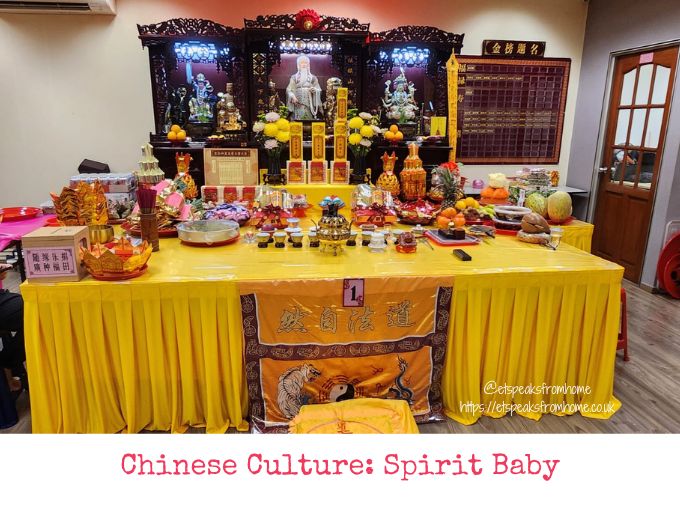
In Chinese culture, they are called 婴灵 (Yīng Líng). They are believed to be the souls of babies who were aborted, miscarried, stillborn, or who died shortly after birth. Often, they are not properly buried—especially in cases of abortion in hospitals, where remains may be disposed of as medical waste. In many cases, they are also not given a name or a memorial tablet.
According to Chinese beliefs, these souls are helpless and may linger in the human world, unable to be reborn. This is thought to be especially true for those who were aborted, as their circumstances may give rise to resentment or unrest. Some believe that such spirits may haunt their loved ones—particularly their biological mother—bringing misfortune or harm to the family.
In my previous post, I shared the experience of exhuming my grandfather’s remains before they were sent for cremation. After the contractors carefully cleaned the bones, they were taken to the crematorium for the next stage of the journey. But what happens after cremation?
What I am sharing here is based solely on the experiences of my uncle and a close friend. These are Chinese funeral customs that some families continue to practise after cremation. They are shared here purely for reference, as traditions vary greatly between countries, cultures, and religions. Not every Chinese family follows the same rituals, and practices may differ depending on dialect group, beliefs, and personal preferences.

Bongeunsa Buddhist temple was founded in 794 during the United Shilla Dynasty, with a 23-metre tall Maitreya Buddha statue. We came across this temple while visiting Starfield COEX mall.

On day 7 of our South Korea trip, we went to the underground shopping mall – Starfield COEX Mall to avoid the rain and to visit Starfield Library! This mall is in the Gangnam District of Seoul, South Korea. It was relatively far away from our location in Myeongdong and it took us nearly 40 minutes to travel there. It is located near Samseong station on Seoul Subway Line 2, at the intersection of Teheranno and Yeongdong Dae-ro.

Jogyesa Temple is the main temple of the Jogye Order and a symbol of Korean Buddhism, and it is located in the heart of Seoul. It was founded in 1910 and is a place to practice Buddhism as well as a centre for education, culture and social services. This is a very impressive and colourful temple. The Main Dharma Hall/Daeungjeon is open 24 hours a day to the public.

On Day 6 of our South Korea trip, we went on a DMZ and Ganghwa Island day tour which we booked via the Klook app. When we first booked this trip, we were unsure if this was the same DMZ trip as we had previously booked. Anyway, after booking it, we realised that this DMZ trip is on the other end of South Korea – Peace Observatory in Ganghwa island. Hence we booked another proper DMZ tour.

Whenever I visit Singapore with friends, I will often take them to Chinatown. Not only to get a feel for the vibe but also to visit the Buddha Tooth Relic Temple and Museum.

In my earlier post on the meaning of the 15 days of the Lunar New Year, I mentioned that on the fourth day, it is the day to pray 太岁/Tài Suì for a year of protection and to avert adversities. Now I am going to tell you more about him.

In many of my Chinese New Year blog and craft posts, I’ve often mentioned that the Lunar New Year celebration lasts for 15 days. However, I realised I had never fully explained the meaning, traditions, and significance behind each day of the festival. Finally, I managed to sit down and gather all the information about the 15 days of Lunar New Year celebrations.
Yes, the 15 days are already over and we are now nearing the end of the first lunar month of the Water Rabbit year 2023! Nevertheless, these traditions are fascinating to learn about and are passed down through generations, so I hope you will still enjoy reading about them.

After we moved from Ang Mo Kio to Bishan, I often visited Kong Meng San Phor Kark See Monastery (光明山普觉禅寺) for praying and to bring me closer to Buddhism. I choose to believe in this religion not because of the influence of my parents. Nevertheless, my dad’s plaque is now situated at Kong Meng San, I have even more reasons to visit when I am back in Singapore.

Since I moved to the UK, whenever I fly back to Singapore, my mum will remind me to give my thanks to the Goddess of the Seas Ma Zu. I always do as I’m told, but I have no idea who she is and why. This was quite embarrassing so I would like to use this opportunity to educate myself and of course, if you happened to travel to Singapore, suggest a visit to this historic temple Thian Hock Keng.
